E7: San Francisco Bay Shoreline Protection*
This project is a partnership with the California State Coastal Conservancy, the U.S. Army Corps of Engineers (USACE) and regional stakeholders to provide tidal flood protection, restore and enhance tidal marsh and related habitats, and provide recreational and public access opportunities along Santa Clara County’s shoreline.
This project relies on federal participation from the USACE to develop the project and prepare the plans. Without federal participation, Valley Water cannot implement planning, design and construction on our own due to limited available funding. The Safe, Clean Water funding provides a portion of the local share of funding for planning, design and construction phases for Economic Impact Areas (EIAs) 1-4, and a portion of the local share of funding for the planning study and design phases for EIAs 5-9.
The 2012 Safe, Clean Water Program has already provided $15 million as a portion of Valley Water’s local share of funding for flood protection improvements in Economic Impact Area (EIA) 11, which is the urban area of North San José and the community of Alviso. Once completed, EIA 11 will provide flood protection to more than 1,000 residential structures and 100 non-residential structures, and allow for the restoration of 2,900 acres of tidal marsh and related habitats.
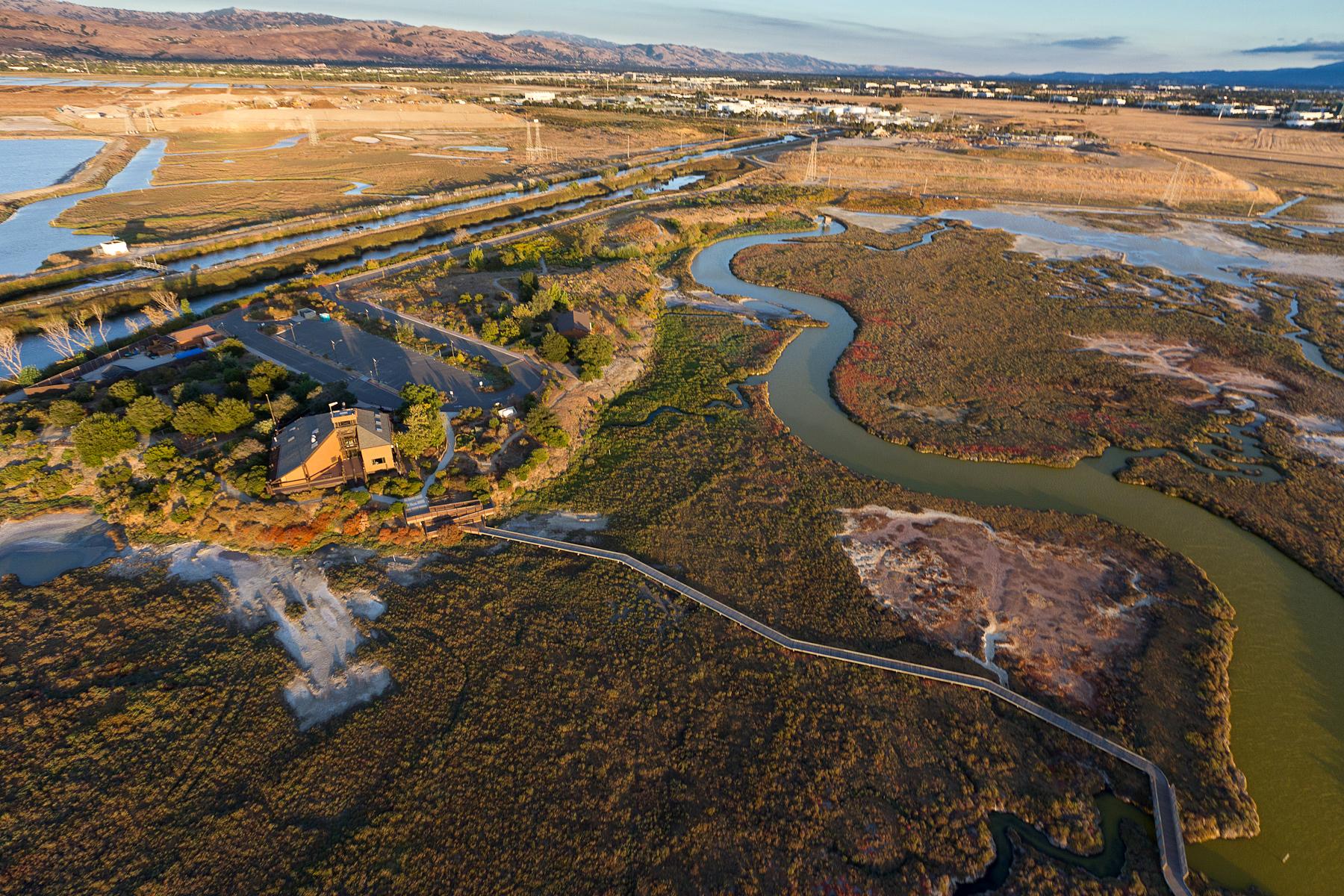
The project will provide coastal flood protection from a rising sea level, and will restore and enhance tidal marsh by using a combination of flood protection levees, wetlands and transitional zone habitats also known as ecotones. Ecotones will provide an additional protective buffer for the levee and allow marsh habitat to migrate upslope as the sea level rises. This approach of using natural infrastructure will help develop a resilient and adaptable flood protection system that can evolve in the future.
(Photograph by Cris Benton)
This is a U.S. Army Corps of Engineers (USACE) led project, in partnership with Valley Water, and the California State Coastal Conservancy (Conservancy). Due to the extent of the project area, the project was split into 11 Economic Impact Areas (EIAs). Phase I of the project includes EIA 11 in the Alviso area of the City of San Jose. Phase II focuses on EIAs 1-4, from San Francisquito Creek in Palo Alto to Permanente Creek in Mountain View. Phase III is also known as the Shoreline (Sunnyvale) Feasibility Study and focuses on the remaining EIAs 5-10, from Permanente Creek in Mountain View to Guadalupe River in San José.
Economic Impact Area 11 (Phase I)
Economic Impact Area (EIA) 11 includes the urban area of North San José, the community of Alviso and the San José-Santa Clara Regional Wastewater Facility. There are five reaches under EIA 11 (Phase I).
To view the map, click here.
Levee construction work on Reaches 1 through 3 began in December 2021 and was successfully completed in Fall 2025. Reach 1 extends from Alviso Marina to the Union Pacific Railroad, and Reaches 2 and 3 stretch from the Union Pacific Railroad to Artesian Slough. Crews have built the Reaches 1 - 3 levee alignment to design elevation 15.2 feet with a 16-foot-wide aggregate base trail on top.
On September 25, 2025, Valley Water, along with its Project partners, held a milestone celebration event to mark the successful construction of the Reach 1-3 flood risk management levee.
To view the livestream, click here.
Pond A12 and A13 ecotone construction is scheduled to begin in early 2026, pending approval of the right of entry. Trail closure information will be provided here and will be posted onsite. Similar to the levee construction work, daily construction hours are expected to be 7 a.m. to 5:30 p.m., Monday through Friday, and on weekends if necessary, excluding holidays. During ecotone construction, there will be no public access to trail users across the berms of Ponds A12 and A13, which are within the construction work area.
To view the previous Reaches 1-3 construction fact sheet, click here.
Reaches 4 and 5, which extend from the Artesian Slough East to Coyote Creek, are in design.
A multi-agency partnership
The Shoreline Project is strongly supported as evidenced by the signing of the USACE Chief's Report in December 2015, with a total Feasibility Study cost of $22 million, followed by its authorization for design and construction in the Water Infrastructure Improvements for the Nation Act in December 2016.
The total project cost is $545 million to implement coastal flood risk management, ecosystem restoration, and recreational project elements. The project has received $124 million under the USACE 2018 Disaster Supplemental Appropriations Bill. California State Coastal Conservancy’s (Conservancy) and Valley Water’s total local cost share of the project is $309 million. Valley Water’s local cost share is $207 million, and the Conservancy’s local cost share is $102 million. Valley Water has secured $15 million from the 2012 Safe, Clean Water Program, $61 million from the San Francisco Bay Restoration Authority’s Measure AA program, and $14.7 million from a Conservancy grant to support Reaches 1-3 and Reaches 4-5 levee construction, respectively. The remaining share of Valley Water funds will be from the Watershed Stream Stewardship Fund and Senate Bill 881 will allow Valley Water to be eligible for reimbursement from the Department of Water Resources (DWR) State Subventions Program, pending DWR funding availability. To date Valley Water has secured $21.62 million from DWR. Future federal appropriations of $17 million will be required for restoration monitoring.
For significant EIA 11 project milestones reached, click here.
Economic Impact Areas 1-4 (Phase II)
Economic Impact Area (EIAs) 1-4 include the shoreline areas located between San Francisquito Creek in Palo Alto and Permanente Creek in Mountain View. It includes the communities of Palo Alto and Mountain View. The Phase II Feasibility Study was concluded in April 2024. See the fact sheet for more information.
Current activities:
- Valley Water is considering alternate means of working with local partners or USACE on smaller projects in the study area to address near-term coastal flooding.
Economic Impact Areas 5-10 (Phase III / Sunnyvale Study)
Economic Impact Area (EIAs) 5-10 include the shoreline areas located between Permanente Creek in Mountain View and the Guadalupe River in San Jose. It includes the communities of Mountain View, NASA, Sunnyvale, San José, and Santa Clara. The Shoreline (Sunnyvale)/Phase III Feasibility Study was initiated in August 2023.
Current activities:
- The USACE’s next planning milestone, the Vertical Team Alignment Memorandum (VTAM) was approved by the South Pacific Division on March 30, 2025, confirming the study's scope, schedule, and budget. The Additional Resources Request for funding above the standard 3x3x3 planning process is still awaiting approval by USACE Headquarters in Washington D.C.
- The USACE is beginning work on engineering investigations including geotechnical borings and bathymetric surveys, and continuing to perform hydraulic modeling and economic analysis for the study area.
- EIA 10: Valley Water is working with the South Bay Salt Pond Restoration Project team to coordinate efforts in EIA 10 (Calabazas/San Tomas Aquino Creek-Marsh Connection Project).
EIAs 5-10 Completed milestones:
- Valley Water completed a Preliminary Feasibility Study in March 2017 for EIAs 1-10.
- Valley Water completed a Visioning effort in 2019 in partnership with the San Francisco Estuary Institute, Google, the City of Sunnyvale, Lockheed Martin, the Midpeninsula Regional Open Space District, NASA, the US Fish and Wildlife Service, and the South Bay Salt Pond Restoration Project. The Vision group successfully lobbied Congress for dedication of funds, increased alignment between stakeholders, explored synergies between individual planning efforts, and gathered data USACE will need for their analysis. An executive summary documenting the Vision group’s efforts was finalized in December 2021 and can be accessed here.
- The Study received federal funding, the Feasibility Cost Share Agreement between Valley Water and USACE was signed, and a kickoff meeting was held in August 2023. The Conservancy signed on as a local sponsor via an amendment in October 2023.
- A planning charrette was held in late November 2023 to identify potential project alternatives and a public scoping meeting was held in February 2024. (See link to meeting materials above) to gather public feedback on the study.
- The Alternatives Milestone Meeting (AMM) Part I was held in April 2024. It included the alternatives that USACE will evaluate as part of the feasibility study. The AMM Part II was held in October 2024. It included recommended cost and schedule for the study.
December 2025
For more information:
South San Francisco Bay Shoreline Project, Phase I (EIA 11, San Jose / Alviso)
- Project Questions: Aimee Green, Public Information Representative, (408) 630-2342
- Sunshine Ventura Julian, Capital Engineering Manager, (408) 630-2273
- Sign up to receive project updates via email
South San Francisco Bay Shoreline Project, Shoreline Phase II Feasibility Study (EIAs 1-4, Palo Alto / Mountain View)
- Erin Baker, Capital Engineering Manager, (408) 630-2608
- Sign up to receive project updates via email
South San Francisco Bay Shoreline Project, Shoreline (Sunnyvale) Feasibility Study (EIAs 5-10, Mountain View / Moffett Federal Airfield / Sunnyvale)
- Erin Baker, Capital Engineering Manager, (408) 630-2608