Pre Header

  • FAQ
  • Permits and District Business
  • Valley Water Websites
Home

Main navigation

    • FAQ
    • Permits and District Business
    • Valley Water Websites
  • For Residents
    Highlights
    Access Valley Water
    Easily send requests, reports or feedback directly to helpful district staff.
    Rebates & Surveys
    Programs and rebates helping you save water and money.
    Water Conservation
    Learn the best ways to save water indoors and outdoors.
    Current Water Charges
    Valley Water is funded by property taxes, well owners, agricultural water customers and water retailers like San Jose Water Company
    Emergency & Planning
    Flood Emergency Action Plans
    Drought Information
    Local Hazard Mitigation Plan
    Get Flood Ready
    Preparation for Extended Power Outages
    Alert System Real Time Data*
    Levee Safety
    Save Water & Money
    Rebates & Surveys
    Watersavings.org
    Current Water Charges
    Water Savings Videos
    Indoor Conservation
    Outdoor Conservation
    Projects & Plans
    Projects In Your Neighbourhood
    Creek & River Projects
    Dam & Reservoir Projects
    Grants and Environmental Protection
    Infrastructure Improvement Projects
    Climate Change Action Plan
    Safe, Clean Water and Natural Flood Protection Programs
    Studies and Reports
    Hydraulic Model Data (HEC)
    Stream Maintenance Program
  • Your Water
    Highlights
    Access Valley Water
    Easily send requests, reports or feedback directly to helpful district staff.
    Current Water Charges
    Valley Water is funded by property taxes, well owners, agricultural water customers and water retailers like San Jose Water Company
    Rebates & Surveys
    Programs and rebates helping you save water and money.
    Water Conservation
    Learn the best ways to save water indoors and outdoors.
    Water Sources
    Groundwater
    Imported Water
    Local Dams and Reservoirs
    Recycled and Purified Water
    Where your water comes from
    Information & Resources
    GIS Data
    Glossary of Water Terms
    District Library
    Popular Documents and Data
    Local Dams and Reservoirs
    Water Planning
    Water Supply Master Plan
    Water Supply Planning
    Water Treatment
    Water Treatment Plants
    Water Quality
  • Learning Center
    Highlights
    Access Valley Water
    Easily send requests, reports or feedback directly to helpful district staff.
    Rebates & Surveys
    Programs and rebates helping you save water and money.
    Water Conservation
    Learn the best ways to save water indoors and outdoors.
    Current Water Charges
    Valley Water is funded by property taxes, well owners, agricultural water customers and water retailers like San Jose Water Company
    Learning & Exploration
    Next Gen Career Pathways Program
    Water Education programs and Events
    Water 101 Academy
    Public Tours
    Local Dams and Reservoirs
    Volunteer Engagement
    Volunteer and Engage
    Valley Water Youth
    Commission
    Adopt a Creek
    Grants & Partnerships
    Public Art
    Environmental Science & Conservation
    Healthy Creeks and Ecosystems
    Watersheds of Santa Clara Valley
    The Water Treatment Process
    Aerial Drone Pilot Program
  • News & Events
    Highlights
    District News
    Learn more about the latest headlines and announcements from around the district
    Events
    Find district events happening on variety of topics
    Valley Water News Blog
    Catch up on all the latest list of articles and blog posts
    Videos
    Stay up to date with the latest videos from the district
    Public Records
    Public Records feature many commonly requested documents and data sets.
    Recent News
    Image
    Box culvert in West Little Llagas Creek
    A look at a completed flood wall as part of the Coyote Creek Flood Management Measures Project.
    January 23, 2026
    Valley Water’s annual Capital Improvement Program: Projects to reduce flood risk 

    Editor’s Note: This is the first in a three-part series highlighting some of the projects included in the Capital Improvement Program Fiscal Year 2027-2031 Preliminary Five-Year Plan.

    Read More
    Image
    Valley Water completes erosion repair project along Saratoga Creek in fall 2025
    January 21, 2026
    Providing flood protection through ongoing stream maintenance projects

    Each summer, under the Stream Maintenance Program (SMP), Valley Water takes important steps to protect neighborhoods from flooding. Over time, sediment can accumulate in creeks, reducing their capacity to carry stormwater. During heavy rains, this can lead to an increased risk of flooding for nearby homes, roads and businesses.

    Read More
    Image
    Mockups Design
    January 7, 2026
    Discover how Valley Water is building climate resilience; read the latest biennial report

    Valley Water’s mission is to provide safe, clean water, protect against flooding, and care for local streams. Climate change is affecting this mission. Rising temperatures, changing rainfall patterns, more severe droughts, a declining Sierra Nevada snowpack and rising sea levels all impact water reliability, infrastructure, and ecosystem health throughout Santa Clara County.

    Read More
  • About Valley Water
    Highlights
    Mission, Vision and Values
    Learn about our core mission, vision for the future, and the values that guide us
    Board of Directors
    Meet the board members who provide leadership and oversight for the district
    Finance/Budget
    Access financial information, budgets, and fiscal reports for transparency
    Committees
    Explore our various committees and their roles in district governance
    Board Meetings, Agendas & Minutes
    Review meeting schedules, agendas, and official minutes from board meetings
    Leadership
    Board of Directors
    Board Meetings Agendas & Minutes
    Committees
    Redistricting
    Board Governance Policies
    Accountability
    Public Records
    Lobbyist Ordinance
    Grand Jury Reports
    Enterprise Systems
    Information & Resources
    Finance/Budget
    Capital Improvement Program
    Public Facilities Financing Corporation
    Community Engagement
    Renewed Safe, Clean Water & Natural Flood Protection: Independent Monitoring Committee
    Committees
    Community Partnering Sponsorship Program
  • Services and Support
Loading…
Home

Main navigation

    • FAQ
    • Permits and District Business
    • Valley Water Websites
  • For Residents
    Highlights
    Access Valley Water
    Easily send requests, reports or feedback directly to helpful district staff.
    Rebates & Surveys
    Programs and rebates helping you save water and money.
    Water Conservation
    Learn the best ways to save water indoors and outdoors.
    Current Water Charges
    Valley Water is funded by property taxes, well owners, agricultural water customers and water retailers like San Jose Water Company
    Emergency & Planning
    Flood Emergency Action Plans
    Drought Information
    Local Hazard Mitigation Plan
    Get Flood Ready
    Preparation for Extended Power Outages
    Alert System Real Time Data*
    Levee Safety
    Save Water & Money
    Rebates & Surveys
    Watersavings.org
    Current Water Charges
    Water Savings Videos
    Indoor Conservation
    Outdoor Conservation
    Projects & Plans
    Projects In Your Neighbourhood
    Creek & River Projects
    Dam & Reservoir Projects
    Grants and Environmental Protection
    Infrastructure Improvement Projects
    Climate Change Action Plan
    Safe, Clean Water and Natural Flood Protection Programs
    Studies and Reports
    Hydraulic Model Data (HEC)
    Stream Maintenance Program
  • Your Water
    Highlights
    Access Valley Water
    Easily send requests, reports or feedback directly to helpful district staff.
    Current Water Charges
    Valley Water is funded by property taxes, well owners, agricultural water customers and water retailers like San Jose Water Company
    Rebates & Surveys
    Programs and rebates helping you save water and money.
    Water Conservation
    Learn the best ways to save water indoors and outdoors.
    Water Sources
    Groundwater
    Imported Water
    Local Dams and Reservoirs
    Recycled and Purified Water
    Where your water comes from
    Information & Resources
    GIS Data
    Glossary of Water Terms
    District Library
    Popular Documents and Data
    Local Dams and Reservoirs
    Water Planning
    Water Supply Master Plan
    Water Supply Planning
    Water Treatment
    Water Treatment Plants
    Water Quality
  • Learning Center
    Highlights
    Access Valley Water
    Easily send requests, reports or feedback directly to helpful district staff.
    Rebates & Surveys
    Programs and rebates helping you save water and money.
    Water Conservation
    Learn the best ways to save water indoors and outdoors.
    Current Water Charges
    Valley Water is funded by property taxes, well owners, agricultural water customers and water retailers like San Jose Water Company
    Learning & Exploration
    Next Gen Career Pathways Program
    Water Education programs and Events
    Water 101 Academy
    Public Tours
    Local Dams and Reservoirs
    Volunteer Engagement
    Volunteer and Engage
    Valley Water Youth
    Commission
    Adopt a Creek
    Grants & Partnerships
    Public Art
    Environmental Science & Conservation
    Healthy Creeks and Ecosystems
    Watersheds of Santa Clara Valley
    The Water Treatment Process
    Aerial Drone Pilot Program
  • News & Events
    Highlights
    District News
    Learn more about the latest headlines and announcements from around the district
    Events
    Find district events happening on variety of topics
    Valley Water News Blog
    Catch up on all the latest list of articles and blog posts
    Videos
    Stay up to date with the latest videos from the district
    Public Records
    Public Records feature many commonly requested documents and data sets.
    Recent News
    Image
    Box culvert in West Little Llagas Creek
    A look at a completed flood wall as part of the Coyote Creek Flood Management Measures Project.
    January 23, 2026
    Valley Water’s annual Capital Improvement Program: Projects to reduce flood risk 

    Editor’s Note: This is the first in a three-part series highlighting some of the projects included in the Capital Improvement Program Fiscal Year 2027-2031 Preliminary Five-Year Plan.

    Read More
    Image
    Valley Water completes erosion repair project along Saratoga Creek in fall 2025
    January 21, 2026
    Providing flood protection through ongoing stream maintenance projects

    Each summer, under the Stream Maintenance Program (SMP), Valley Water takes important steps to protect neighborhoods from flooding. Over time, sediment can accumulate in creeks, reducing their capacity to carry stormwater. During heavy rains, this can lead to an increased risk of flooding for nearby homes, roads and businesses.

    Read More
    Image
    Mockups Design
    January 7, 2026
    Discover how Valley Water is building climate resilience; read the latest biennial report

    Valley Water’s mission is to provide safe, clean water, protect against flooding, and care for local streams. Climate change is affecting this mission. Rising temperatures, changing rainfall patterns, more severe droughts, a declining Sierra Nevada snowpack and rising sea levels all impact water reliability, infrastructure, and ecosystem health throughout Santa Clara County.

    Read More
  • About Valley Water
    Highlights
    Mission, Vision and Values
    Learn about our core mission, vision for the future, and the values that guide us
    Board of Directors
    Meet the board members who provide leadership and oversight for the district
    Finance/Budget
    Access financial information, budgets, and fiscal reports for transparency
    Committees
    Explore our various committees and their roles in district governance
    Board Meetings, Agendas & Minutes
    Review meeting schedules, agendas, and official minutes from board meetings
    Leadership
    Board of Directors
    Board Meetings Agendas & Minutes
    Committees
    Redistricting
    Board Governance Policies
    Accountability
    Public Records
    Lobbyist Ordinance
    Grand Jury Reports
    Enterprise Systems
    Information & Resources
    Finance/Budget
    Capital Improvement Program
    Public Facilities Financing Corporation
    Community Engagement
    Renewed Safe, Clean Water & Natural Flood Protection: Independent Monitoring Committee
    Committees
    Community Partnering Sponsorship Program
  • Services and Support
Loading…
  • Almaden Lake Improvement Project
  • Canal Maintenance Program
  • Lower Berryessa Creek Flood Protection
  • Lower Berryessa Creek Flood Protection (Phase 3)*
  • Upper Berryessa Creek Flood Protection*
  • Calabazas Creek Bank Rehabilitation Project
  • Calabazas/San Tomas Aquino Creek-Marsh Connection Project
  • Coyote Creek Flood Protection*
  • Cunningham Flood Detention Certification
  • Ecological Data Collection and Analysis*
  • FAHCE: Fish and Aquatic Habitat Collaborative Effort
    • FAHCE Final Program Environmental Impact Report
    • FAHCE-Related Board Committee Items
    • FAHCE: Adaptive Management Program
    • FAHCE: Fish Monitoring Program
    • FAHCE-Related Board Agenda Items
    • FAHCE: Certified Final EIR
  • Fish Habitat and Passage Improvement*
  • Flood Risk Assessment Studies*
  • Lower Guadalupe River Project
  • Upper Guadalupe River Flood Protection*
  • Interagency Urban Runoff Program*
  • Upper Llagas Creek Flood Protection*
  • Palo Alto Flood Basin Tide Gate Structure Replacement Project
  • Upper Penitencia Creek Flood Protection*
  • Lower Penitencia Creek Improvements Project
  • Restoration of Natural Creek Functions*
  • Permanente Creek Flood Protection*
  • San Francisco Bay Shoreline Protection*
  • San Francisquito Creek: Bay to Highway 101
  • San Francisquito Creek Flood Protection*
  • Saratoga Creek Hazard Tree Removal and Restoration Project
  • Sediment Reuse to Support Shoreline Restoration*
  • Sunnyvale East and Sunnyvale West Channels Flood Protection*
  • Vegetation Control and Sediment Removal for Capacity*
  • Vegetation Management for Access and Fire Safety*
  • Uvas Creek Levee Rehabilitation

Breadcrumb

  1. Home
  2. Project Updates
  3. D5: Ecological Data Collection and Analysis*

D5: Ecological Data Collection and Analysis*

Image
VW biologists conduct CRAM survey on SCC creek
Status
Active
Location
Countywide
Schedule
Start FY 2022 / Finish FY 2036
Funding
Safe, Clean Water Fund ($7.6 million); Watershed Stream Stewardship Fund

This project continues to build and update watershed data to track stream ecosystem conditions, helping Valley Water and other county agencies and organizations make informed watershed, asset management and natural resource decisions. The new and updated information will be used to develop or modernize integrated watershed plans (such as watershed profiles, One Water Plan and Stream Corridor Priority Plans) that identify potential projects, support grant applications, environmental analyses and permits, and are shared with land use agencies, environmental groups, and the public to make efficient and coordinated environmental decisions throughout the county. These data and plans will help integrate and enhance Valley Water’s programs, projects, maintenance and stewardship actions through standardized, repeatable and defensible measurements that guide, organize and integrate information on stream and habitat conditions.

Measuring changes in ecological conditions through time allows Valley Water, resource agencies, land managers and the public to understand and respond to climate change effects and evolving creek and habitat conditions.


*This project was voter approved as part of the Safe, Clean Water and Natural Flood Protection Program.

KPI #1: Reassess and track stream ecological conditions and habitats in each of the county’s five (5) watersheds every 15 years.

In FY26 Q1 (July 1, 2025 – September 30, 2025), Valley Water and its contractors, San Francisco Estuary Institute/Aquatic Science Center (SFEI-ASC) and SWCA Environmental Consultants, completed the field work for the 10-year reassessment of the Upper Pajaro River watershed using the California Rapid Assessment Method (CRAM). 90 sites were surveyed to capture conditions in the different sub-watersheds: Pacheco Creek, Uvas Creek, Llagas Creek, Pajaro River, and smaller tributaries. During the data collection effort, field crew members participated in calibration trainings to ensure that CRAM data is collected in a correct and consistent manner during the field season. SWCA Environmental Consultants is now entering all of the data and SFEI-ASC will analyze the collected data and prepare the reassessment report later in FY26.

Valley Water uses CRAM to assess  the ecological condition of creeks in Santa Clara County’s five major watersheds and document changes over time. You can learn more about the methodology at cramwetlands.org. The CRAM scores that form the basis of the watershed assessments, and for numerous County creeks, lakes, and wetlands, can be accessed on EcoAtlas.
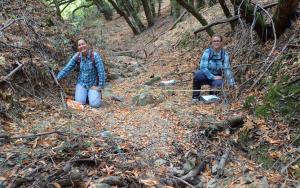
CRAM survey crew at work on a Guadalupe Creek tributary.
CRAM survey crew starting work on a Llagas Creek tributary.


KPI #2: Provide up to $500,000 per 15-year period toward the development and updates of five (5) watershed plans that include identifying priority habitat enhancement opportunities in Santa Clara County.

Valley Water is working with the San Francisco Estuary Institute/Aquatic Science Center (SFEI-ASC) to develop the Upper Pajaro Native Ecosystem Enhancement Tool (UPNEET). UPNEET builds from the One Water Watershed Master Plan for the Upper Pajaro River Watershed to identify more detailed habitat enhancement action and opportunity area assessment and mapping, and utilizes the platform, programming, and structure of the Coyote Creek Native Ecosystem Enhancement Tool (CCNEET – see below for more details). In FY25, SFEI-ASC completed the programming and submitted the beta version of the tool for review by the UPNEET Technical Advisory Committee (TAC), which includes outside technical experts in the fields of wildlife, geomorphology, fisheries, water quality, agriculture, and tribal involvement. In FY26 Q1 (July 1, 2025 – September 30, 2025), Valley Water reviewed and provided comments on the beta version of UPNEET and SFEI-ASC compiled and began to address TAC comments.

Project D5 continues to help maintain and update the Coyote Creek Native Ecosystem Enhancement Tool (CCNEET), an online decision-support tool to identify and coordinate habitat actions to improve ecological conditions along Coyote Creek, from Anderson Dam to Montague Expressway. Inspired by the need for a watershed approach to environmental resource management, project planning, and permitting, an overarching goal of CCNEET is to help coordinate habitat conservation and enhancement so that multiple projects and limited funding can result in meaningful ecological improvement of the creek. CCNEET is now available for use without a username or password. You can learn more about CCNEET here and see first-hand how Project D5 data has been applied to watershed and ecological enhancement planning. 


October 2025

For more information:

  • Zooey Diggory, (408) 630-2851
Safe Clean Water and Natural Flood Protection Interactive Map


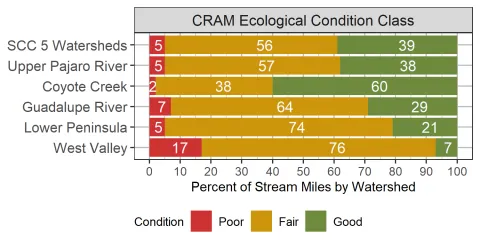
Ecological condition of creeks in Santa Clara County’s five major watersheds using the California Rapid Assessment Method (CRAM)
Ecological condition of creeks in Santa Clara County’s five major watersheds using the California Rapid Assessment Method (CRAM) (“SCC 5 Watersheds” is all of the watersheds combined)


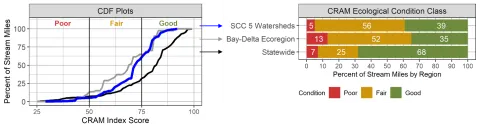
Ecological condition of creeks in Santa Clara County’s five major watersheds combined, using the California Rapid Assessment Method (CRAM), compared with those in the San Francisco Bay Sacramento-San Joaquin River Delta ecoregion and California statewide

Click here for an enlarged version of the above chart.


KPI #1: Reassess and track stream ecological conditions and habitats in each of the county’s five (5) watersheds every 15 years.

In FY26 Q1 (July 1, 2025 – September 30, 2025), Valley Water and its contractors, San Francisco Estuary Institute/Aquatic Science Center (SFEI-ASC) and SWCA Environmental Consultants, completed the field work for the 10-year reassessment of the Upper Pajaro River watershed using the California Rapid Assessment Method (CRAM). 90 sites were surveyed to capture conditions in the different sub-watersheds: Pacheco Creek, Uvas Creek, Llagas Creek, Pajaro River, and smaller tributaries. During the data collection effort, field crew members participated in calibration trainings to ensure that CRAM data is collected in a correct and consistent manner during the field season. SWCA Environmental Consultants is now entering all of the data and SFEI-ASC will analyze the collected data and prepare the reassessment report later in FY26.

Valley Water uses CRAM to assess  the ecological condition of creeks in Santa Clara County’s five major watersheds and document changes over time. You can learn more about the methodology at cramwetlands.org. The CRAM scores that form the basis of the watershed assessments, and for numerous County creeks, lakes, and wetlands, can be accessed on EcoAtlas.
CRAM survey crew at work on a Guadalupe Creek tributary.
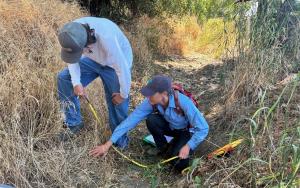
CRAM survey crew starting work on a Llagas Creek tributary.


KPI #2: Provide up to $500,000 per 15-year period toward the development and updates of five (5) watershed plans that include identifying priority habitat enhancement opportunities in Santa Clara County.

Valley Water is working with the San Francisco Estuary Institute/Aquatic Science Center (SFEI-ASC) to develop the Upper Pajaro Native Ecosystem Enhancement Tool (UPNEET). UPNEET builds from the One Water Watershed Master Plan for the Upper Pajaro River Watershed to identify more detailed habitat enhancement action and opportunity area assessment and mapping, and utilizes the platform, programming, and structure of the Coyote Creek Native Ecosystem Enhancement Tool (CCNEET – see below for more details). In FY25, SFEI-ASC completed the programming and submitted the beta version of the tool for review by the UPNEET Technical Advisory Committee (TAC), which includes outside technical experts in the fields of wildlife, geomorphology, fisheries, water quality, agriculture, and tribal involvement. In FY26 Q1 (July 1, 2025 – September 30, 2025), Valley Water reviewed and provided comments on the beta version of UPNEET and SFEI-ASC compiled and began to address TAC comments.

Project D5 continues to help maintain and update the Coyote Creek Native Ecosystem Enhancement Tool (CCNEET), an online decision-support tool to identify and coordinate habitat actions to improve ecological conditions along Coyote Creek, from Anderson Dam to Montague Expressway. Inspired by the need for a watershed approach to environmental resource management, project planning, and permitting, an overarching goal of CCNEET is to help coordinate habitat conservation and enhancement so that multiple projects and limited funding can result in meaningful ecological improvement of the creek. CCNEET is now available for use without a username or password. You can learn more about CCNEET here and see first-hand how Project D5 data has been applied to watershed and ecological enhancement planning. 


October 2025

For more information:

  • Zooey Diggory, (408) 630-2851
Safe Clean Water and Natural Flood Protection Interactive Map


Ecological condition of creeks in Santa Clara County’s five major watersheds using the California Rapid Assessment Method (CRAM)
Ecological condition of creeks in Santa Clara County’s five major watersheds using the California Rapid Assessment Method (CRAM) (“SCC 5 Watersheds” is all of the watersheds combined)


Ecological condition of creeks in Santa Clara County’s five major watersheds combined, using the California Rapid Assessment Method (CRAM), compared with those in the San Francisco Bay Sacramento-San Joaquin River Delta ecoregion and California statewide

Click here for an enlarged version of the above chart.


The best of Santa Clara County's native vegetation!

Valley Water completed a detailed documentation of the composition and conditions of Santa Clara County’s most pristine native plant communities. The study included numerous regionally native vegetation communities, with an emphasis on wetland and riparian habitats. At over 300 sample plots, the Vegetation Rapid Assessment method (modified from California Native Plant Society 2018 online at https://www.cnps.org/plant-science/field-protocols-guidelines) was used to document plant species, percent cover, and key physical conditions, and vegetation classified under the Manual of California Vegetation (Sawyer et al. 2009 online at https://vegetation.cnps.org/). This understanding improves restoration and mitigation project designs and success, helps standardize permit conditions, and increases climate resiliency of projects. While the study method details, data analyses, and results are still being prepared, we are excited to share the study’s raw data here. Please direct any questions to the project contact listed on this page, and stay tuned for the accompanying report.

Baseline Assessments

The first, or baseline, assessments of stream ecological condition in each of Santa Clara County’s five major watersheds are available:

  • Coyote Creek (2010) including Upper Penitencia Creek
  • Guadalupe River (2012) urban and non-urban
  • Lower San Francisco Bay peninsula creeks in Santa Clara County (2016) including San Francisquito, Adobe, and Stevens-Permanente creeks
  • Pajaro River in Santa Clara County (2015) including Pacheco, Llagas, and Uvas creeks
  • West Valley Watershed (2018) including Sunnyvale, Saratoga-San Tomas Aquino and Calabazas creeks 

Synthesis report of stream ecological condition in all five of Santa Clara County’s major watersheds (2020), with comparisons between the watersheds and with statewide and San Francisco Bay Delta ecoregion. Examples applying CRAM to project and mitigation performance, and a watershed approach are also provided.

2015 State of the Estuary overview poster: Stream health of the Coyote Creek and Guadalupe River watersheds using California's Wetland and Riparian Area Monitoring Plan (WRAMP).

2017 presentation: Using the California Rapid Assessment Method (CRAM) to Quantify Riverine Riparian Condition in Santa Clara County Watersheds.

Watershed Reassessment Reports

The reassessment of stream ecological condition in the Coyote Creek watershed (2020), includes a comparison with the 2010 results.

The reassessment of stream ecological condition in the Guadalupe River watershed (2022), includes a comparison with the 2012 results.

Related Information:

  • Using the California Rapid Assessment Method (CRAM) for project assessment as an element of regulatory, grant, and other management programs (2019 Technical Bulletin), including guidance for regulatory/permitting compliance.
  • The Healthy Watersheds Partnership is devoted to monitoring and assessing the quality of California’s stream and river ecosystems, and bringing the resulting information to decision makers and the public.
  • 2013 California Integrated Assessment of Watershed Health report by the US EPA Healthy Watersheds Protection.
  • 2015 Perennial Streams Assessment (PSA) by CA State Water Resources Control Board, Surface Water Ambient Monitoring Program (SWAMP).
  • 2015 California Stream Condition Index (CSCI) SWAMP stream health and CSCI Scores Map.
  • 2015 California Central Coast Healthy Watersheds Project report card with trend analysis. For data and other information, see the Central Coast Regional Water Quality Control Board's Central Coast Ambient Monitoring Program (CCAMP), including the Pajaro River, Uvas-Carnadero and Llagas Creeks.
  • California Environmental Data Exchange Network (CEDEN) is a central location to find and share information about California’s water bodies, including streams, lakes, rivers, and the coastal ocean. CEDEN aggregates data and makes it accessible to environmental managers and the public.
  • United States Geological Survey (USGS) California Stream Quality Assessment (CSQA)

 Safe, Clean Water Program Documents

  • FY25 Annual Report
  • All annual reports, annual IMC audit reports and independent audits


Key Performance Indicators (FY22–36)

  1. Reassess and track stream ecological conditions and habitats in each of the county’s five (5) watersheds every 15 years.
  2. Provide up to $500,000 per 15-year period toward the development and updates of five (5) watershed plans that include identifying priority habitat enhancement opportunities in Santa Clara County.

Benefits

  • Improves natural resource, watershed and asset management decisions
  • Provides a systematic, scientific guide for decisions and actions to improve stream conditions
  • Supports effective and environmentally sound design options
  • Provides reliable data on countywide stream conditions and basis for measuring the success of past mitigation and environmental stewardship project projects
  • Facilitates a watershed approach to resource management, permitting and restoration planning
  • Supports climate change adaptation by providing data to better understand its effects on local habitats to enable increased habitat resiliency

Geographic Area of Benefit

Countywide

About the Safe, Clean Water and Natural Flood Protection Program

In November 2020, voters in Santa Clara County overwhelmingly approved Measure S, a renewal of Valley Water’s Safe, Clean Water and Natural Flood Protection Program.

The program was first passed by voters in 2000 as the Clean, Safe Creeks and Natural Flood Protection Plan, then again in 2012 as the Safe, Clean Water and Natural Flood Protection Program. The renewal of the Safe, Clean Water Program will continue to provide approximately $47 million annually for local projects that deliver safe, clean water, natural flood protection, and environmental stewardship to all the communities we serve in Santa Clara County.

While evaluating ways to improve the 2012 program, Valley Water gathered feedback from more than 21,000 community members. That helped Valley Water create the six priorities for the renewed Safe, Clean Water Program, which are:

Priority A: Ensure a Safe, Reliable Water Supply

Priority B: Reduce Toxins, Hazards and Contaminants in our Waterways

Priority C: Protect our Water Supply and Dams from Earthquakes and Other Natural Disasters

Priority D: Restore Wildlife Habitat and Provide Open Space

Priority E: Provide Flood Protection to Homes, Businesses, Schools, Streets and Highways

Priority F: Support Public Health and Public Safety for Our Community

Each year, Valley Water prepares a report providing a progress update for each of these program priorities, along with fiscal year accomplishments.

To ensure transparency and accountability to the voters, the ballot measure also created an Independent Monitoring Committee, appointed by the Santa Clara Valley Water District Board of Directors. The Independent Monitoring Committee annually reviews the program’s progress to ensure the outcomes are achieved in a cost-efficient manner and reports its findings to the Board. Additionally, the IMC also reviews each proposed 5-year implementation plan prior to its submittal for Board approval.

In addition, the program requires three independent audits.

View the Safe, Clean Water Program’s annual reports, annual IMC audit reports, and independent audits, including a staff response, on the Valley Water website.

Footer Top

    Valley Water Logo
  • Report an Issue
  • Contact Us
  • Services & Support
  • Join our Newsletter
    Valley Water Logo
  • Join our Newsletter
  • Report an Issue
  • Contact Us
  • Services & Support

Footer

  • For Residents
    • Water Charges
    • Grants and Rebates
    • Water Conservation
    • Projects and Plans
    • Outdoor Survey
    • Watersavings.org
    • Water Quality
    • Water Supply Planning
  • In an Emergency
    • Get Flood Ready
    • Levee Safety
    • Dam Safety Program
    • Flood Emergency Action Plan
    • Local Hazard Mitigation Area
    • Climate Change Action Plan
  • Data & Resources
    • GIS Data
    • Popular Documents
    • HEC-2 Data Library
    • Surface Water Data Portal
    • Water Sensor ALERT
    • Find My Water Retailer
  • About Valley Water
    • Finance & Budget
    • Board of Directors
    • Board Meetings & Agendas
    • Committees
    • Board Governance Policies
    • Careers
    • Internships
  • In the District
    • Permits
    • Report a Problem
    • Contact Us
    • Purchasing and Contracts
    • Construction Administration
    • Business Resources
  • Learning Center
    • Water 101 Academy
    • Public Tours
    • Adopt a Creek
Santa Clara Valley Water District 2025
Pollution Hotline 888-510-5151
Phone: 408-265-2600