Pre Header

  • FAQ
  • Permits and District Business
  • Valley Water Websites
Home

Main navigation

    • FAQ
    • Permits and District Business
    • Valley Water Websites
  • For Residents
    Highlights
    Access Valley Water
    Easily send requests, reports or feedback directly to helpful district staff.
    Rebates & Surveys
    Programs and rebates helping you save water and money.
    Water Conservation
    Learn the best ways to save water indoors and outdoors.
    Current Water Charges
    Valley Water is funded by property taxes, well owners, agricultural water customers and water retailers like San Jose Water Company
    Emergency & Planning
    Flood Emergency Action Plans
    Drought Information
    Local Hazard Mitigation Plan
    Get Flood Ready
    Preparation for Extended Power Outages
    Alert System Real Time Data*
    Levee Safety
    Save Water & Money
    Rebates & Surveys
    Watersavings.org
    Current Water Charges
    Water Savings Videos
    Indoor Conservation
    Outdoor Conservation
    Projects & Plans
    Projects In Your Neighbourhood
    Creek & River Projects
    Dam & Reservoir Projects
    Grants and Environmental Protection
    Infrastructure Improvement Projects
    Climate Change Action Plan
    Safe, Clean Water and Natural Flood Protection Programs
    Studies and Reports
    Hydraulic Model Data (HEC)
    Stream Maintenance Program
  • Your Water
    Highlights
    Access Valley Water
    Easily send requests, reports or feedback directly to helpful district staff.
    Current Water Charges
    Valley Water is funded by property taxes, well owners, agricultural water customers and water retailers like San Jose Water Company
    Rebates & Surveys
    Programs and rebates helping you save water and money.
    Water Conservation
    Learn the best ways to save water indoors and outdoors.
    Water Sources
    Groundwater
    Imported Water
    Local Dams and Reservoirs
    Recycled and Purified Water
    Where your water comes from
    Information & Resources
    GIS Data
    Glossary of Water Terms
    District Library
    Popular Documents and Data
    Local Dams and Reservoirs
    Water Planning
    Water Supply Master Plan
    Water Supply Planning
    Water Treatment
    Water Treatment Plants
    Water Quality
  • Learning Center
    Highlights
    Access Valley Water
    Easily send requests, reports or feedback directly to helpful district staff.
    Rebates & Surveys
    Programs and rebates helping you save water and money.
    Water Conservation
    Learn the best ways to save water indoors and outdoors.
    Current Water Charges
    Valley Water is funded by property taxes, well owners, agricultural water customers and water retailers like San Jose Water Company
    Learning & Exploration
    Next Gen Career Pathways Program
    Water Education programs and Events
    Water 101 Academy
    Public Tours
    Local Dams and Reservoirs
    Volunteer Engagement
    Volunteer and Engage
    Valley Water Youth
    Commission
    Adopt a Creek
    Grants & Partnerships
    Public Art
    Environmental Science & Conservation
    Healthy Creeks and Ecosystems
    Watersheds of Santa Clara Valley
    The Water Treatment Process
    Aerial Drone Pilot Program
  • News & Events
    Highlights
    District News
    Learn more about the latest headlines and announcements from around the district
    Events
    Find district events happening on variety of topics
    Valley Water News Blog
    Catch up on all the latest list of articles and blog posts
    Videos
    Stay up to date with the latest videos from the district
    Public Records
    Public Records feature many commonly requested documents and data sets.
    Recent News
    Image
    Box culvert in West Little Llagas Creek
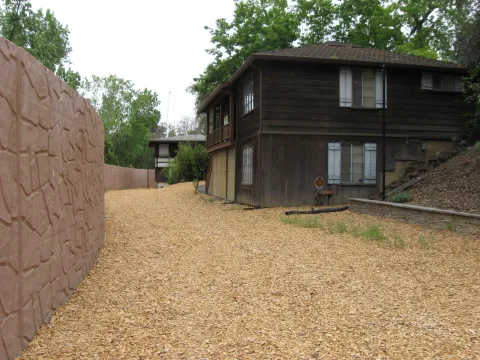
    A look at a completed flood wall as part of the Coyote Creek Flood Management Measures Project.
    January 23, 2026
    Valley Water’s annual Capital Improvement Program: Projects to reduce flood risk 

    Editor’s Note: This is the first in a three-part series highlighting some of the projects included in the Capital Improvement Program Fiscal Year 2027-2031 Preliminary Five-Year Plan.

    Read More
    Image
    Valley Water completes erosion repair project along Saratoga Creek in fall 2025
    January 21, 2026
    Providing flood protection through ongoing stream maintenance projects

    Each summer, under the Stream Maintenance Program (SMP), Valley Water takes important steps to protect neighborhoods from flooding. Over time, sediment can accumulate in creeks, reducing their capacity to carry stormwater. During heavy rains, this can lead to an increased risk of flooding for nearby homes, roads and businesses.

    Read More
    Image
    Mockups Design
    January 7, 2026
    Discover how Valley Water is building climate resilience; read the latest biennial report

    Valley Water’s mission is to provide safe, clean water, protect against flooding, and care for local streams. Climate change is affecting this mission. Rising temperatures, changing rainfall patterns, more severe droughts, a declining Sierra Nevada snowpack and rising sea levels all impact water reliability, infrastructure, and ecosystem health throughout Santa Clara County.

    Read More
  • About Valley Water
    Highlights
    Mission, Vision and Values
    Learn about our core mission, vision for the future, and the values that guide us
    Board of Directors
    Meet the board members who provide leadership and oversight for the district
    Finance/Budget
    Access financial information, budgets, and fiscal reports for transparency
    Committees
    Explore our various committees and their roles in district governance
    Board Meetings, Agendas & Minutes
    Review meeting schedules, agendas, and official minutes from board meetings
    Leadership
    Board of Directors
    Board Meetings Agendas & Minutes
    Committees
    Redistricting
    Board Governance Policies
    Accountability
    Public Records
    Lobbyist Ordinance
    Grand Jury Reports
    Enterprise Systems
    Information & Resources
    Finance/Budget
    Capital Improvement Program
    Public Facilities Financing Corporation
    Community Engagement
    Renewed Safe, Clean Water & Natural Flood Protection: Independent Monitoring Committee
    Committees
    Community Partnering Sponsorship Program
  • Services and Support
Loading…
Home

Main navigation

    • FAQ
    • Permits and District Business
    • Valley Water Websites
  • For Residents
    Highlights
    Access Valley Water
    Easily send requests, reports or feedback directly to helpful district staff.
    Rebates & Surveys
    Programs and rebates helping you save water and money.
    Water Conservation
    Learn the best ways to save water indoors and outdoors.
    Current Water Charges
    Valley Water is funded by property taxes, well owners, agricultural water customers and water retailers like San Jose Water Company
    Emergency & Planning
    Flood Emergency Action Plans
    Drought Information
    Local Hazard Mitigation Plan
    Get Flood Ready
    Preparation for Extended Power Outages
    Alert System Real Time Data*
    Levee Safety
    Save Water & Money
    Rebates & Surveys
    Watersavings.org
    Current Water Charges
    Water Savings Videos
    Indoor Conservation
    Outdoor Conservation
    Projects & Plans
    Projects In Your Neighbourhood
    Creek & River Projects
    Dam & Reservoir Projects
    Grants and Environmental Protection
    Infrastructure Improvement Projects
    Climate Change Action Plan
    Safe, Clean Water and Natural Flood Protection Programs
    Studies and Reports
    Hydraulic Model Data (HEC)
    Stream Maintenance Program
  • Your Water
    Highlights
    Access Valley Water
    Easily send requests, reports or feedback directly to helpful district staff.
    Current Water Charges
    Valley Water is funded by property taxes, well owners, agricultural water customers and water retailers like San Jose Water Company
    Rebates & Surveys
    Programs and rebates helping you save water and money.
    Water Conservation
    Learn the best ways to save water indoors and outdoors.
    Water Sources
    Groundwater
    Imported Water
    Local Dams and Reservoirs
    Recycled and Purified Water
    Where your water comes from
    Information & Resources
    GIS Data
    Glossary of Water Terms
    District Library
    Popular Documents and Data
    Local Dams and Reservoirs
    Water Planning
    Water Supply Master Plan
    Water Supply Planning
    Water Treatment
    Water Treatment Plants
    Water Quality
  • Learning Center
    Highlights
    Access Valley Water
    Easily send requests, reports or feedback directly to helpful district staff.
    Rebates & Surveys
    Programs and rebates helping you save water and money.
    Water Conservation
    Learn the best ways to save water indoors and outdoors.
    Current Water Charges
    Valley Water is funded by property taxes, well owners, agricultural water customers and water retailers like San Jose Water Company
    Learning & Exploration
    Next Gen Career Pathways Program
    Water Education programs and Events
    Water 101 Academy
    Public Tours
    Local Dams and Reservoirs
    Volunteer Engagement
    Volunteer and Engage
    Valley Water Youth
    Commission
    Adopt a Creek
    Grants & Partnerships
    Public Art
    Environmental Science & Conservation
    Healthy Creeks and Ecosystems
    Watersheds of Santa Clara Valley
    The Water Treatment Process
    Aerial Drone Pilot Program
  • News & Events
    Highlights
    District News
    Learn more about the latest headlines and announcements from around the district
    Events
    Find district events happening on variety of topics
    Valley Water News Blog
    Catch up on all the latest list of articles and blog posts
    Videos
    Stay up to date with the latest videos from the district
    Public Records
    Public Records feature many commonly requested documents and data sets.
    Recent News
    Image
    Box culvert in West Little Llagas Creek
    A look at a completed flood wall as part of the Coyote Creek Flood Management Measures Project.
    January 23, 2026
    Valley Water’s annual Capital Improvement Program: Projects to reduce flood risk 

    Editor’s Note: This is the first in a three-part series highlighting some of the projects included in the Capital Improvement Program Fiscal Year 2027-2031 Preliminary Five-Year Plan.

    Read More
    Image
    Valley Water completes erosion repair project along Saratoga Creek in fall 2025
    January 21, 2026
    Providing flood protection through ongoing stream maintenance projects

    Each summer, under the Stream Maintenance Program (SMP), Valley Water takes important steps to protect neighborhoods from flooding. Over time, sediment can accumulate in creeks, reducing their capacity to carry stormwater. During heavy rains, this can lead to an increased risk of flooding for nearby homes, roads and businesses.

    Read More
    Image
    Mockups Design
    January 7, 2026
    Discover how Valley Water is building climate resilience; read the latest biennial report

    Valley Water’s mission is to provide safe, clean water, protect against flooding, and care for local streams. Climate change is affecting this mission. Rising temperatures, changing rainfall patterns, more severe droughts, a declining Sierra Nevada snowpack and rising sea levels all impact water reliability, infrastructure, and ecosystem health throughout Santa Clara County.

    Read More
  • About Valley Water
    Highlights
    Mission, Vision and Values
    Learn about our core mission, vision for the future, and the values that guide us
    Board of Directors
    Meet the board members who provide leadership and oversight for the district
    Finance/Budget
    Access financial information, budgets, and fiscal reports for transparency
    Committees
    Explore our various committees and their roles in district governance
    Board Meetings, Agendas & Minutes
    Review meeting schedules, agendas, and official minutes from board meetings
    Leadership
    Board of Directors
    Board Meetings Agendas & Minutes
    Committees
    Redistricting
    Board Governance Policies
    Accountability
    Public Records
    Lobbyist Ordinance
    Grand Jury Reports
    Enterprise Systems
    Information & Resources
    Finance/Budget
    Capital Improvement Program
    Public Facilities Financing Corporation
    Community Engagement
    Renewed Safe, Clean Water & Natural Flood Protection: Independent Monitoring Committee
    Committees
    Community Partnering Sponsorship Program
  • Services and Support
Loading…
  • Almaden Lake Improvement Project
  • Canal Maintenance Program
  • Lower Berryessa Creek Flood Protection
  • Lower Berryessa Creek Flood Protection (Phase 3)*
  • Upper Berryessa Creek Flood Protection*
  • Calabazas Creek Bank Rehabilitation Project
  • Calabazas/San Tomas Aquino Creek-Marsh Connection Project
  • Coyote Creek Flood Protection*
  • Cunningham Flood Detention Certification
  • Ecological Data Collection and Analysis*
  • FAHCE: Fish and Aquatic Habitat Collaborative Effort
    • FAHCE Final Program Environmental Impact Report
    • FAHCE-Related Board Committee Items
    • FAHCE: Adaptive Management Program
    • FAHCE: Fish Monitoring Program
    • FAHCE-Related Board Agenda Items
    • FAHCE: Certified Final EIR
  • Fish Habitat and Passage Improvement*
  • Flood Risk Assessment Studies*
  • Lower Guadalupe River Project
  • Upper Guadalupe River Flood Protection*
  • Interagency Urban Runoff Program*
  • Upper Llagas Creek Flood Protection*
  • Palo Alto Flood Basin Tide Gate Structure Replacement Project
  • Upper Penitencia Creek Flood Protection*
  • Lower Penitencia Creek Improvements Project
  • Restoration of Natural Creek Functions*
  • Permanente Creek Flood Protection*
  • San Francisco Bay Shoreline Protection*
  • San Francisquito Creek: Bay to Highway 101
  • San Francisquito Creek Flood Protection*
  • Saratoga Creek Hazard Tree Removal and Restoration Project
  • Sediment Reuse to Support Shoreline Restoration*
  • Sunnyvale East and Sunnyvale West Channels Flood Protection*
  • Vegetation Control and Sediment Removal for Capacity*
  • Vegetation Management for Access and Fire Safety*
  • Uvas Creek Levee Rehabilitation

Breadcrumb

  1. Home
  2. Project Updates
  3. Creek & River Projects
  4. E1: Coyote Creek Flood Protection*

E1: Coyote Creek Flood Protection*

Status
Active; Adjusted
Phase
Design
Location
San José
Schedule
Start FY 2022 / Finish FY 2029
Funding
Safe, Clean Water Fund ($206.1 million)

This project is to plan, design and construct improvements along approximately nine (9) miles of Coyote Creek, between Montague Expressway and Tully Road, in San José. The primary objective is to provide protection from floods up to the level that occurred on February 21, 2017, equivalent to approximately a 5% flood (20-year event). In December 2019, the Valley Water Board of Directors voted to allocate local funding for construction of the preferred project; however, Valley Water is also exploring additional external funding sources and partnership opportunities.

Since 2017, Valley Water has implemented several short-term interim projects to help reduce the risk of flooding along Coyote Creek. These include the installation of an interim floodwall and embankment along the creek in the Rock Springs community. This structure protects the Rock Springs community from a flood event equivalent to the February 2017 flood. Other interim projects include repairing a 150-foot levee adjacent to the South Bay Mobile Home Park, installing flood gauges on bridges that provide real-time visual information on water levels and removing invasive vegetation from Valley Water and City property in parts of the creek that experienced the most flooding.
*This project was voter approved as part of the Safe, Clean Water and Natural Flood Protection Program.

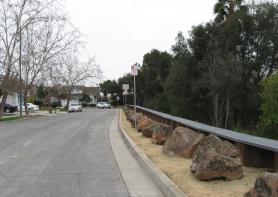
Notting Hill behind vegetation
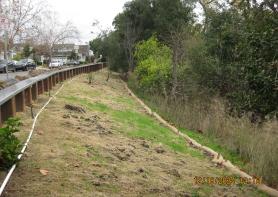
A floodwall was installed along Notting Hill Dr. Coyote Creek is behind the vegetation seen on the right side of the wall.
Backside of the Notting Hill
The backside of the floodwall along Notting Hill Dr. shows the irrigation lines to support the planted native vegetation.

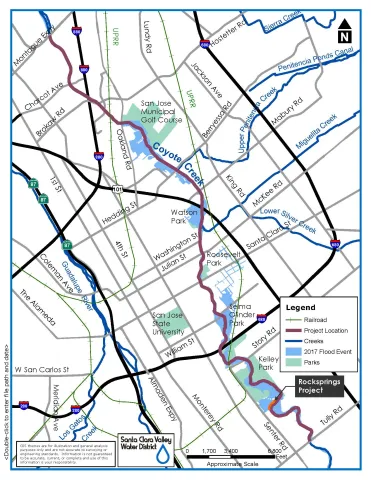
The Coyote Creek Flood Protection Project comprises two projects: the Coyote Creek Flood Management Measures for the FERC Order Compliance Project (CCFMMP or Phase 1) and the Coyote Creek Flood Protection Project (CCFPP or Phase 2). These phases cover a 9-mile stretch of Coyote Creek between Montague Expressway and Tully Road. This area is divided into several geographic segments known as reaches, which are shown on the map to the right.

Phase 1 (CCFMMP) has been completed, and flood risk reduction measures have been constructed in the most vulnerable areas in reaches 5, 6, and 7. Valley Water’s Board of Directors accepted the work as complete and filed the Notice of Completion of Contract in June, 2025.

Phase 2 (CCFPP) is in the final design phase, with staff actively evaluating critical data from various areas along Coyote Creek. This phase will implement the remaining flood risk reduction measures in reaches 4 through 8. Construction is anticipated to commence in mid-2026 and is expected to be completed by the end of 2028. 

Coyote Creek Flood Protection Project (CCFPP or Phase 2)

Park closures for construction
There will be temporary park closures in the summer of 2026 to allow crews to begin constructing the flood risk reduction measures. The length of the closures will vary by park. We have developed a Frequently Asked Questions (FAQ) to address the most frequently asked project-related questions and upcoming activities. The FAQ is available in English, Spanish, and Vietnamese. Click on your preferred language to view the FAQ.

Final Environmental Impact Report
Valley Water's Board of Directors certified the Final Environmental Impact Report on March 11, 2025. The Final EIR and the following documents are available to view:

  • Final Certified EIR
  • Resolution
  • PowerPoint Presentation
  • Project Delivery Process

Coyote Creek Flood Management Measures Project (CCFMMP or Phase 1, Complete)

The construction of the flood risk reduction measures for the CCFMMP are in place, and a three-year plant establishment period remains. Below are maps and a summary of completed measures from Old Oakland Road to Highway 280. Workers installed metal pieces called sheet piles along Coyote Creek, using a press-in method that produces less noise than typical construction techniques. To view a video of this work in action, click here. 

Completed CCFMMP Flood Risk Reduction Measures
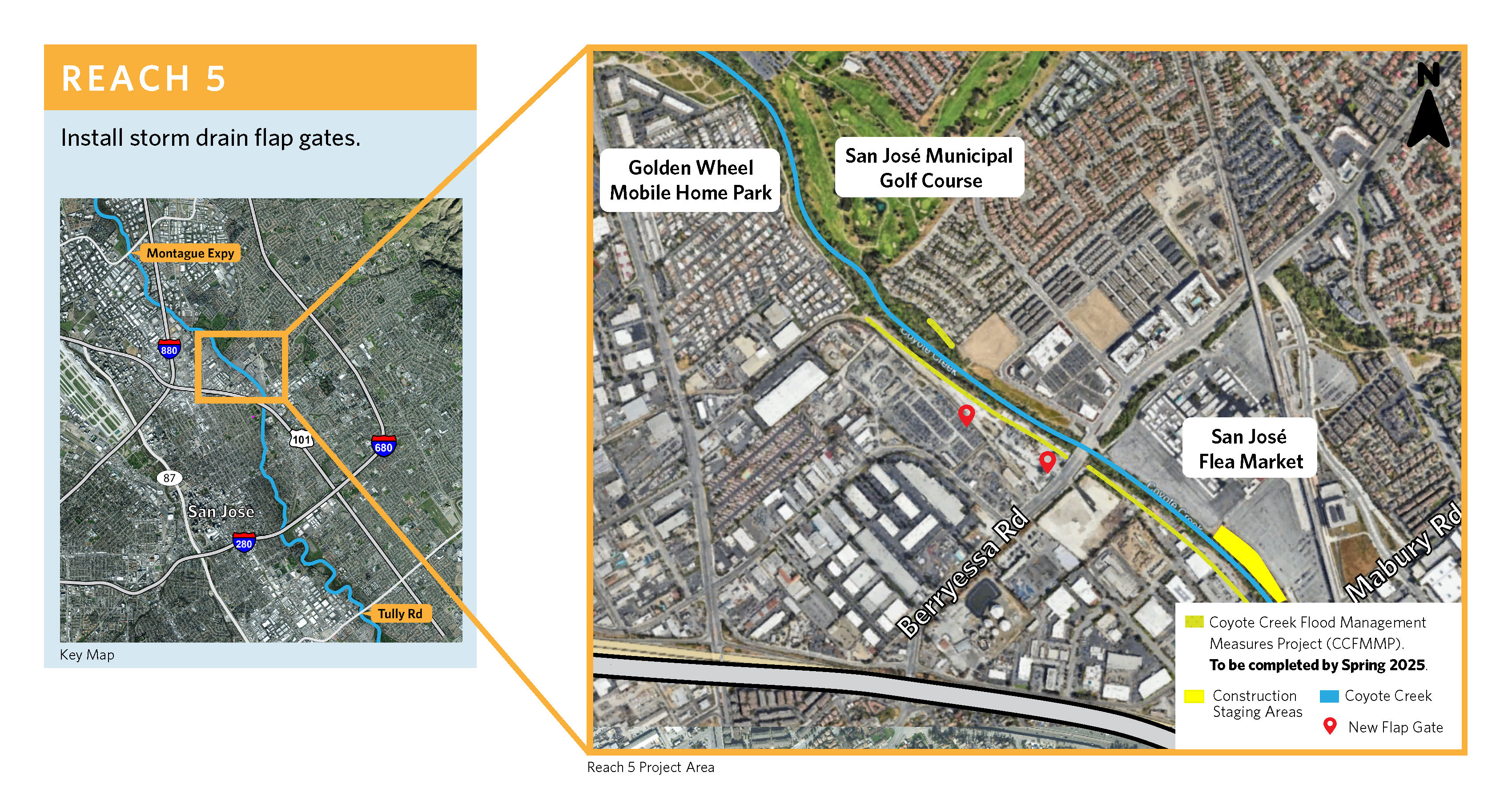
Reach 5: San Jose Municipal Golf Course to Mabury Rd and creek ownership map, reach 5.
Crews installed floodwalls along the west bank of Coyote Creek north and south of Berryessa Rd. and on a portion of Notting Hill Dr.
Reach 6: Mabury Rd. to U.S. Highway 101 and creek ownership map, reach 6
Crews installed floodwalls along the west bank of Coyote Creek north of Highway 101 and south of Mabury Road. 

Reach 7: Santa Clara Street to South end of William Street Park and creek ownership map, reach 7
Crews installed floodwalls along the west bank of Coyote Creek north of East San Antonio Street and south of Santa Clara Street. 

Mid-2026 Construction site-maps
The Coyote Creek Flood Protection Project (CCFPP) is in the design phase. The following maps provide details of the locations and type of flood risk reduction measures.

  • Reach 4: Montague Expressway to E. Brokaw Rd.
  • Reach 5: Oakland Road to Mabury Road
  • Reach 6: Mabury Rd to East bank of Coyote Creek behind Empire Gardens Elementary School
  • Reach 7: Coyote Creek Classroom to Selma Olinder Park/Highway 280
  • Reach 8: Highway 280 to Tully Rd.

Progress on Coyote Creek Video and Blog Posts
Click here to see our progress in action as crews install floodwalls along Coyote Creek in San Jose. Visit Valley Water's News Blog to read about the projects and community input. 
Past public meetings
Materials from past public meetings are located in the Reports & Documents section.

Are you Flood Ready?
Climate change has made extreme weather the new normal, and as the rainy season approaches, Valley Water encourages you to take some time to ensure you are ready in case of a flood. It’s important to remember that floods can happen anytime it rains.
It’s important to plan ahead in the event of a flood or any other emergency. Follow these Get Flood Ready essential flood tips to keep your family, home, and business safe and prepared BEFORE an emergency. You can also view our 2026 'Be Alert, Be Flood Safe' flipbook, which provides valuable flood safety and preparation information in four languages.  


January 2026


For more information:

  • CCFMMP or Phase 1 – Robert Yamane, (408) 630-2925
  • CCFPP or Phase 2 – Caitlin McAlpine, (408) 630-2202
  • Project Outreach: Jose Villarreal, (408) 630-2879
  • Sign up to receive project updates via email.
The map shows the reaches, or sections of Coyote Creek, where the flood risk reduction measures will be built.


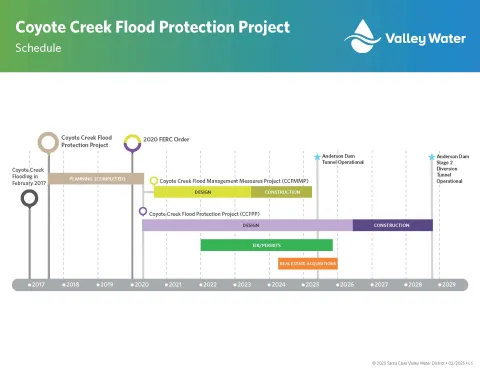
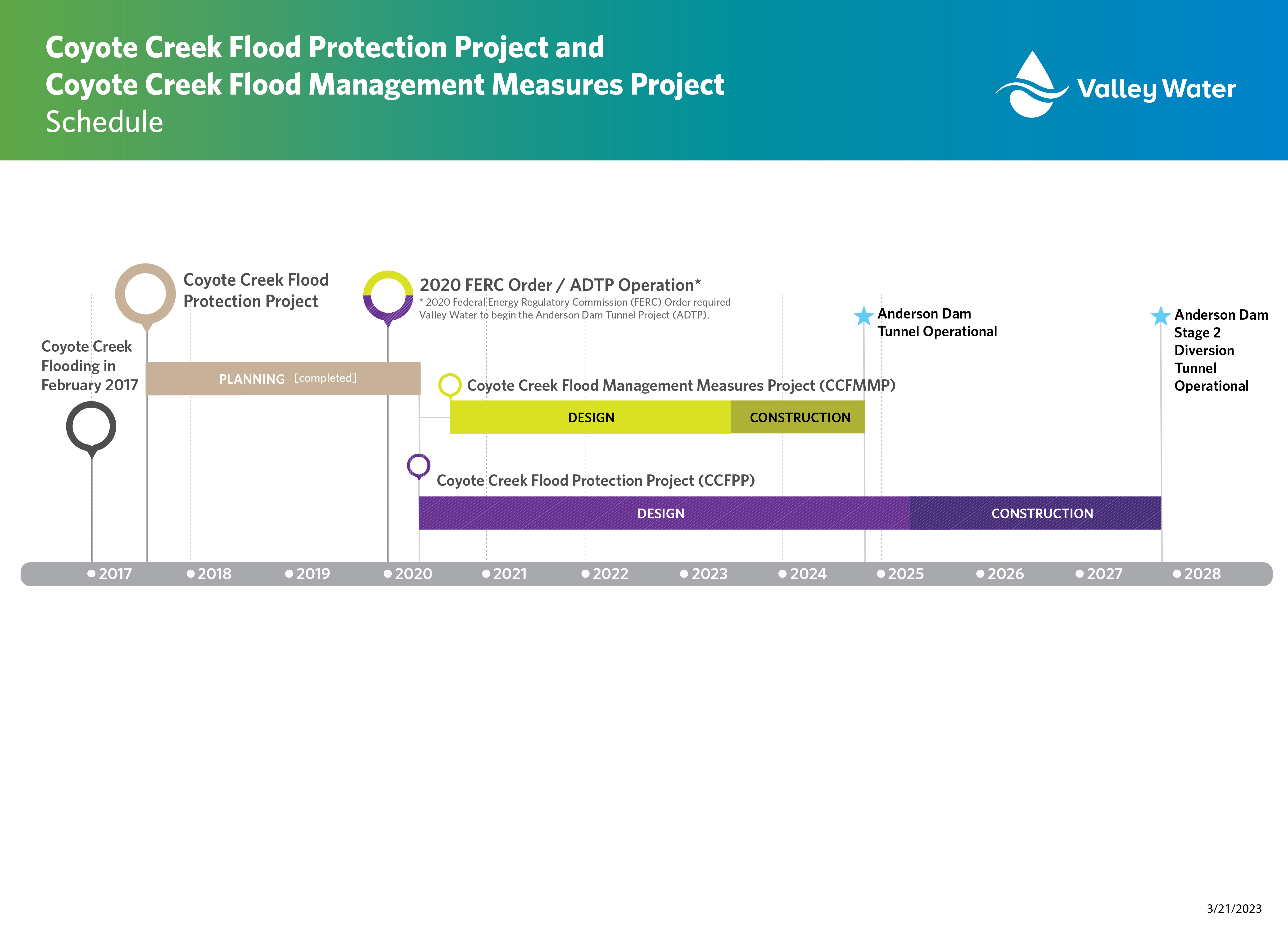
2025 CCFPP Schedule with EIR and RE bars
Above is the timeline for both Coyote Creek projects, along with the Anderson Dam Tunnel Project
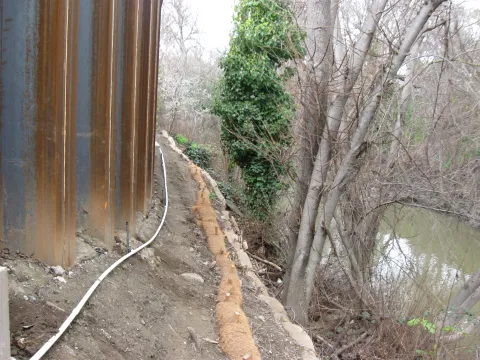
This is the backside of the floodwall facing Coyote Creek behind a home along South 17th St.


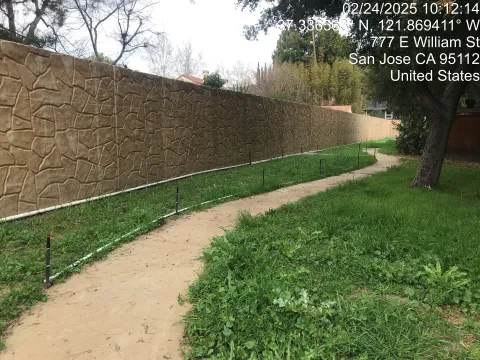
This floodwall is located at the outdoor Coyote Creek Classroom on William St.
The front side of the floodwall facing the backyard of a home on Arroyo Way.


The Coyote Creek Flood Protection Project comprises two projects: the Coyote Creek Flood Management Measures for the FERC Order Compliance Project (CCFMMP or Phase 1) and the Coyote Creek Flood Protection Project (CCFPP or Phase 2). These phases cover a 9-mile stretch of Coyote Creek between Montague Expressway and Tully Road. This area is divided into several geographic segments known as reaches, which are shown on the map to the right.

Phase 1 (CCFMMP) has been completed, and flood risk reduction measures have been constructed in the most vulnerable areas in reaches 5, 6, and 7. Valley Water’s Board of Directors accepted the work as complete and filed the Notice of Completion of Contract in June, 2025.

Phase 2 (CCFPP) is in the final design phase, with staff actively evaluating critical data from various areas along Coyote Creek. This phase will implement the remaining flood risk reduction measures in reaches 4 through 8. Construction is anticipated to commence in mid-2026 and is expected to be completed by the end of 2028. 

Coyote Creek Flood Protection Project (CCFPP or Phase 2)

Park closures for construction
There will be temporary park closures in the summer of 2026 to allow crews to begin constructing the flood risk reduction measures. The length of the closures will vary by park. We have developed a Frequently Asked Questions (FAQ) to address the most frequently asked project-related questions and upcoming activities. The FAQ is available in English, Spanish, and Vietnamese. Click on your preferred language to view the FAQ.

Final Environmental Impact Report
Valley Water's Board of Directors certified the Final Environmental Impact Report on March 11, 2025. The Final EIR and the following documents are available to view:

  • Final Certified EIR
  • Resolution
  • PowerPoint Presentation
  • Project Delivery Process

Coyote Creek Flood Management Measures Project (CCFMMP or Phase 1, Complete)

The construction of the flood risk reduction measures for the CCFMMP are in place, and a three-year plant establishment period remains. Below are maps and a summary of completed measures from Old Oakland Road to Highway 280. Workers installed metal pieces called sheet piles along Coyote Creek, using a press-in method that produces less noise than typical construction techniques. To view a video of this work in action, click here. 

Completed CCFMMP Flood Risk Reduction Measures
Reach 5: San Jose Municipal Golf Course to Mabury Rd and creek ownership map, reach 5.
Crews installed floodwalls along the west bank of Coyote Creek north and south of Berryessa Rd. and on a portion of Notting Hill Dr.
Reach 6: Mabury Rd. to U.S. Highway 101 and creek ownership map, reach 6
Crews installed floodwalls along the west bank of Coyote Creek north of Highway 101 and south of Mabury Road. 

Reach 7: Santa Clara Street to South end of William Street Park and creek ownership map, reach 7
Crews installed floodwalls along the west bank of Coyote Creek north of East San Antonio Street and south of Santa Clara Street. 

Mid-2026 Construction site-maps
The Coyote Creek Flood Protection Project (CCFPP) is in the design phase. The following maps provide details of the locations and type of flood risk reduction measures.

  • Reach 4: Montague Expressway to E. Brokaw Rd.
  • Reach 5: Oakland Road to Mabury Road
  • Reach 6: Mabury Rd to East bank of Coyote Creek behind Empire Gardens Elementary School
  • Reach 7: Coyote Creek Classroom to Selma Olinder Park/Highway 280
  • Reach 8: Highway 280 to Tully Rd.

Progress on Coyote Creek Video and Blog Posts
Click here to see our progress in action as crews install floodwalls along Coyote Creek in San Jose. Visit Valley Water's News Blog to read about the projects and community input. 
Past public meetings
Materials from past public meetings are located in the Reports & Documents section.

Are you Flood Ready?
Climate change has made extreme weather the new normal, and as the rainy season approaches, Valley Water encourages you to take some time to ensure you are ready in case of a flood. It’s important to remember that floods can happen anytime it rains.
It’s important to plan ahead in the event of a flood or any other emergency. Follow these Get Flood Ready essential flood tips to keep your family, home, and business safe and prepared BEFORE an emergency. You can also view our 2026 'Be Alert, Be Flood Safe' flipbook, which provides valuable flood safety and preparation information in four languages.  


January 2026


For more information:

  • CCFMMP or Phase 1 – Robert Yamane, (408) 630-2925
  • CCFPP or Phase 2 – Caitlin McAlpine, (408) 630-2202
  • Project Outreach: Jose Villarreal, (408) 630-2879
  • Sign up to receive project updates via email.
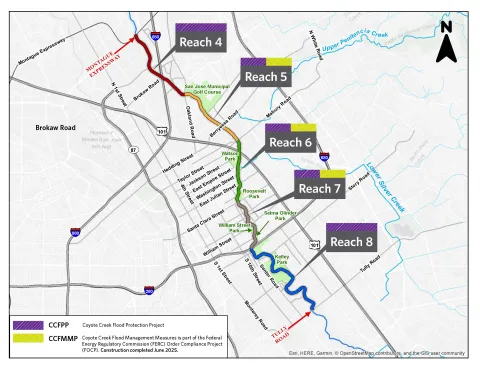
The map shows the reaches, or sections of Coyote Creek, where the flood risk reduction measures will be built.


2025 CCFPP Schedule with EIR and RE bars
Above is the timeline for both Coyote Creek projects, along with the Anderson Dam Tunnel Project
This is the backside of the floodwall facing Coyote Creek behind a home along South 17th St.


This floodwall is located at the outdoor Coyote Creek Classroom on William St.
The front side of the floodwall facing the backyard of a home on Arroyo Way.


Final Environmental Impact Report

The Final EIR includes all public comments received during the Draft EIR public review period, responses to those comments, and changes to the Draft EIR to address the comments received as well as minor staff-initiated changes. The Final EIR was certified on March 11, 2025, by the District's Board of Directors. The EIR and Notice of Determination are available for download at the following links below:

  • Final EIR
  • Final EIR Chapters
  • Attachment 1 to the Final EIR
  • EIR Appendices
  • Notice of Determination

Draft Environmental Impact Report

The Draft EIR identified significant environmental impacts for the following resource topics: biological resources; cultural resources and tribal cultural resources; geology, soils, and seismicity; hazards and hazardous materials; noise and vibration; and transportation and traffic. Many of these impacts were determined to be less than significant after implementing proposed mitigation measures; however, construction impacts related to noise and vibration were determined to be significant and unavoidable. The DEIR was published on July 12, 2024, and was circulated for a 45-day public review period. A public meeting was also held in July 2024 to provide information on DEIR and share details on how to submit comments. The DEIR and the information shared at that meeting are available for download at the following links below:

  • Draft Environmental Impact Report
  • Draft EIR Appendices
  • Individual chapters
  • Individual appendices
  • Notice of Completion
  • Recording of public meeting

Project information is available to download. To view the PowerPoint presentation from the July meeting, click here.

Coyote Creek Flood Protection Project Design Update

Valley Water hosted two public meetings for the Coyote Creek Flood Protection Project. Staff provided an update on the project’s flood protection measures designed to reduce the risk of flooding from an event equivalent to the February 2017 storm event. The project information included details about the flood protection measures to be built along Coyote Creek and at Kelley, Rocksprings, Selma Olinder, Watson, and William Street Parks. 

April 3, 2025
A timeline update for Phase 2 of the project was provided.

  • Agenda
  • Presentation
  • Survey
  • Stream Maintenance Fact Sheet
  • Recoding of meeting
  • Meeting notice

April 17, 2024

  • Meeting recording
  • Meeting Agenda
  • Coyote Creek Flood Protection Project Presentation

April 18, 2024

  • Meeting recording
  • Meeting Agenda
  • Coyote Creek Flood Protection Project Presentation

Dec. 6 Coyote Creek Flood Protection Project Notice of Preparation and Scoping Meeting

A Notice of Preparation (NOP) and Scoping Meeting on the Environmental Impact Report (EIR) for the Coyote Creek Flood Protection Project was held on December 6, 2023. Meeting participants learned about the project and asked questions about the scope and content of the information. Valley Water has received public comments, which will be addressed in the future Draft EIR.  The Notice of Preparation of a Draft Environmental Impact Report is available for download. The comment period is now closed. Materials from the Dec. 6 meeting are available to download. 

  • Agenda
  • Presentation
  • Coyote Creek Flood Protection Project maps of reaches (work areas) 4, 6, 7, and 8
  • Proposed Flood Risk Reduction Measures and Locations
  • Coyote Creek Flood Protection Project information
  • Recording of meeting

June 2023 Pre-construction Meetings
Valley Water hosted two pre-construction public meetings for the Coyote Creek Flood Management Measures Project (CCFMMP). Information shared included the planned work, potential impacts on the surrounding areas, and the anticipated project schedule.
Golden Wheel Mobile Home Park
- Agenda
- Presentation
- Survey
- Meeting recording  

Roosevelt Community Center 
- Agenda
- Presentation
- Survey
- Meeting recording

Board of Directors project update
Valley Water's Board of Directors approved the construction contract for the phase 1 project. The May 16, 2023, agenda (item 6.1) contains the staff memo and other project materials. A recording of the board meeting is available to view. The plans and specifications for the project are part of the February 28, 2023, board meeting. Links to the plans and specifications are located under item 3.3 of the agenda, and the meeting recording is also available for viewing. 

May 2022 Open House Events
Valley water hosted two in-person open house events to share details on the Coyote Creek Flood Management Measures Project (CCFMMP). This project includes reaches 5 and parts of 6 and 7. The same project information was shared at both open-house events. Here are the links to the boards that were on display:

  • Coyote Creek Flood Protection Project and Coyote Creek Flood Management Measures Project timeline
  • Coyote Creek accomplishments (English, Spanish, and Vietnamese)
  • Project information, map, and timeline (English, Spanish, and Vietnamese)
  • Display Boards with flood protection elements (3 slides)

You can also view a recording of the open house from our YouTube page.
Public meetings for the remaining reaches of the Coyote Creek Flood Protection Project, 4, 8, and parts of 6 and 7, will be held in late 2023. 
February 2022 Public Meeting
Valley Water hosted a virtual public meeting to update neighbors on the Coyote Creek Flood Protection Project and the Coyote Creek Flood Measures Project. Information on the projects’ aesthetics and related design details was shared with attendees who responded to poll questions as options were presented. Information about anticipated project timelines and future public engagement opportunities in the spring and summer was also shared. Here is a link to the recorded meeting.
The results from the aesthetic elements survey are available. The final tally includes results from the meeting and post-survey. The final results are consistent with the input received during the meeting. You can view the presentation for details on the options and visuals shared for each section of the project. 
The presentation is available to download. 
October 2021 Public Park Meetings
Valley Water, in partnership with the City of San Jose’s Parks, Recreation and Neighborhood Services Department, hosted three public meetings to receive neighborhood input on the proposed flood protection elements located in the City’s parks. Valley Water presented renderings of the various flood reduction elements and a mockup of the preferred alternatives at each park. The collected input will help Valley Water refine further the selected flood reduction alternatives as the projects proceed to the 30% design phase.
October 7 Rocksprings Park and Coyote Meadows
Meeting Materials
-  Video recording of the meeting
- Agenda
- Informational sheet
- Survey and comment card
Display Board for Reach 8
  - South 12 Street Apartment Buildings
  - Map of Property Parcels
  - Project Overview Map
  - Installing Floodwalls and Berm to protect residential, business, and industrial areas
  - Rocksprings Community and Bevin Brook
  - Existing Floodwalls and Berm

October 13 Selma Olinder Park and William Street Park
Meeting Materials 
- Video recording of the meeting
- Agenda
- Informational project sheet
- Survey and comment card
- Frequently Asked Questions
Display Boards for Reach 7 
- Project Overview Map
- Reach 7 Ownership Map
- Conceptual Berms
- Passive Barrier
- William Street Park
October 14 Watson Park 
Meeting Materials 
- Video recording of the meeting
- Agenda
- Informational project sheet
- Survey and comment card
Display Boards for Reach 6
- Reach 6 Coyote Creek Ownership Map
- Reach 6 Watson Park
- Project Overview Map
Display Boards for Reaches 4 and 5
- Reach 4 Ownership Map
- Reach 5 Ownership Map


July 2021
Valley Water hosted a meeting to update neighbors on the Coyote Creek Flood Protection Project and the Federal Energy Regulatory Commission Order Compliance Project, known as the Coyote Creek Flood Management Measures Project. Valley Water provided an update on the project’s progress, current efforts, and next steps as we prepare for fall public meetings (meeting notice).

Meeting materials
  - Watch the meeting video
  - Agenda
  - Presentation
  - Frequently Asked Questions (FAQ)

June 2020
Virtual public meetings were held in June 2020 to present the preferred project alternatives to the public and stakeholders. 

June 10 focused on the communities of Golden Wheel, Riverbend, and South Bay mobile home parks.

  • Watch the meeting video
  • Agenda
  • Presentations:
    • Anderson Dam Seismic Retrofit Project
    • Coyote Creek Flood Protection Project (reaches 4 to 5)
  • Reaches 4 to 5 preferred alternatives poster board
  • Anderson Dam Seismic Retrofit Project materials

June 11 focused on the communities of Bevin Brook, Nordale, and Rock Springs.

  • Watch meeting video
  • Agenda
  • Presentations
    • Anderson Dam Seismic Retrofit Project
    • Coyote Creek Flood Protection Project (reach 8)
  • Reach 8 preferred alternatives poster board
  • Anderson Dam Seismic Retrofit Project materials

June 17 focused on the communities of Bonita-24th Street, Brookwood Terrace, Five Wounds, Julian-St. James, Naglee Park, Olinder, Roosevelt, and Wooster.

  • Watch meeting video
  • Agenda
  • Presentations
    • Anderson Dam Seismic Retrofit Project
    • Coyote Creek Flood Protection Project (reaches 6 & 7)
  • Reaches 6 & 7 preferred alternatives poster board
  • Anderson Dam Seismic Retrofit Project materials

The following presentation was provided to the San Jose Parks Advocates. The presentation is solely focused on the proposed alternatives for Watson, William Street, Selma Olinder, Coyote Meadows, and Rocksprings parks.

January 2020

  - SJ Parks Advocates presentation

November 2019
In November another series of public meetings were held to get community input during the planning phase of the project.

November 13 at the Roosevelt Community Center:

  • Meeting Agenda
  • Presentation
  • Facebook live stream

November 7at the Franklin McKinley School District:

  • Meeting Agenda
  • Presentation
  • Facebook live stream
  • Meeting video

November 6 at the Golden Wheel Mobile Home Park (Club House):

  • Meeting Agenda
  • Presentation
  • Facebook live stream
  • Meeting video

June 2019
The following is a series of meetings held to update the community and solicit input on the planning phase of the project.
June 3 at the Roosevelt Community Center:

  • Agenda
  • Presentation
  • Reaches 6 and 7 Spilling Map
  • Reaches 6 and 7 Conceptuals
  • Facebook Live meeting video

May 30 at the Franklin-McKinley School District:

  • Agenda
  • Presentation
  • Reach 5 Railroad - Cross Sections Poster
  • Reach 8 Spilling Map
  • Reach 8 Conceptual
  • 1. History and Location
  • 2. Reaches and Cross Sections
  • 3. Conceptual William Street Park
  • 4. Conceptual Arroyo Way #1
  • 5. Conceptual Flea Market
  • 6. Conceptual Arroyo Way #2
  • Facebook Live meeting video

May 21 at the San Jose Conservation Corps:

  • Agenda
  • Presentation
  • Reaches 4 and 5 Breakout Locations: Montague Expw to Mabury Rd.
  • Reached 4 and 5 Conceptual: Montague Expw to Mabury Rd
  • Resolution announcement and frequently asked questions
  • Facebook Live meeting video


Frequently Asked Questions

Public meetings were held in May, June, and November of 2019. Questions from those meetings were combined and summarized to develop the content of this comprehensive 2020 FAQ document. Please note that many of the questions were addressed during those public presentations and video recordings of them are available to view in the above presentations.
Relocation Plan
Here is a link to the Relocation Plan, which only affects the thirteen identified properties that received a mailed notice. Although a final decision has not been made for any of the 13 properties, federal and state laws require Valley Water to develop a Relocation Plan. California law also requires that a Relocation Plan be adopted by the lead agency’s governing board, even when final property decisions have not been made. 
Planning Study Report (PSR)
The PSR for the Coyote Creek Flood Protection Project and Coyote Creek Flood Management Measures Project documents the planning phase project formulation for reducing the current risk of flooding along Coyote Creek from Montague Expressway to Tully Road in San Jose.
Coyote Creek Study Reports
Fisheries 

  • Baseline Fisheries Monitoring Report Year 1 (2007)
  • Baseline Fisheries Monitoring Report Year 2 (2008)

Vegetation and wildlife assessment:

  • Aug. 2006 - Biological Resources Assessment, Coyote Creek

A Valley Water sponsored study of the Coyote Creek historical ecology done by the San Francisco Bay Estuary Institute in 2006.

  • Executive Summary - Coyote Creek watershed Historical Ecology study
  • Final Report - Coyote Creek Watershed Historical Ecology Study - part 1
  • Final Report - Coyote Creek Watershed Historical Ecology Study - part 2
  • Final Report - Coyote Creek Watershed Historical Ecology Study - part 3
  • Final Report - Coyote Creek Watershed Historical Ecology Study - part 4

Safe, Clean Water Program Documents

  • FY25 Annual Report
  • All annual reports, annual IMC audit reports and independent audits

FY22-36 Key Performance Indicator for the Safe, Clean Water Program

  1. Construct flood protection improvements along Coyote Creek between Montague Expressway and Tully Road to provide protection from floods up to the level that occurred on February 21, 2017, approximately a 5% (20-year) flood event.

Benefits 

  • Protects approximately 600 parcels from the level of flooding that occurred on February 21, 2017, approximately a 5% flood
  • Improves water quality, enhances stream habitat and increases recreational opportunities
  • Provides opportunities to incorporate revegetation and aesthetic elements to the Coyote Creek park chain in the project
  • Addresses climate change as the project is designed to increase flow capacity, thereby reducing flood risks from storm events projected to become more frequent and intense due to climate change. Additionally, Valley Water considered the implications of sea level rise (SLR) and determined that the project is outside SLR impact reach

Geographic Area of Benefit 

San José - The project area is approximately 9 miles from Montague Expressway upstream to Tully Road.

Map of the Mid-Coyote Creek Project
Click or tap to enlarge map.

Flooding History 

Flooding has occurred many times within the Coyote Creek Watershed, including along portions of Coyote Creek in 1911, 1917, 1931, 1958, 1969, 1982, 1983, 1997, 1998, and 2017. The largest flow recorded on Coyote Creek was 25,000 cubic feet per second in 1911, before the construction of the current two water-supply reservoirs in the upper watershed. The worst flooding in the project reach since Anderson Reservoir was constructed in 1950 occurred in February 2017. Coyote Creek overtopped its banks at several locations between Montague Expressway and Tully Road. Businesses and hundreds of homes were inundated by creek waters for many hours. Highway 101 near Watson Park and various local streets were closed due to flooding, and thousands of residents had to be evacuated and sheltered.

Project Background

The Coyote Creek Flood Protection Project was initially part of the voter-approved Clean, Safe Creeks and Natural Flood Protection Plan (CSC Plan) that came into effect in Fiscal Year 2001-2002 (FY02). The project entailed planning, designing, and partially constructing flood protection measures along an approximately six-mile stretch of Coyote Creek, extending upstream of Montague Expressway to Interstate 280. The project objective was to protect 1,400 parcels from 1% flood eventually. 

Under the CSC Plan, Valley Water performed geomorphic and floodplain analysis, prepared a problem definition report, held multiple community meetings to receive input, completed conceptual alternatives analysis, and prepared the Planning Study Report (PSR). A range of conceptual alternatives was developed to address the Coyote Creek Project objectives and the cost of all the alternatives significantly exceeded the project budget. In 2011, the 100-year (1%) flood risk reduction improvements cost was estimated between $500 million and $1 billion. With no federal funding, Valley Water proceeded to design only the downstream reaches of the Coyote Creek Project (Montague Expressway to Highway 880). 

Voters Approve the 2012 Safe, Clean Water Program

In November 2012, voters approved the Safe, Clean Water and Natural Flood Protection Program (2012 Program), which replaced the CSC Plan. The project was continued in the 2012 Program with the key performance indicator (KPI) to “Complete construction of downstream project elements.” 

The project was delayed due to various developments, including extremely high project cost estimates and the absence of federal funding, which was critical to Valley Water’s ability to construct the project. Furthermore, potentially feasible project alternatives for a 1% level of protection depended significantly on the outcome of various ongoing projects, including the Anderson Dam Seismic Retrofit Project, which could impact the flows into Coyote Creek. As a result, in FY16, the project was placed on hold until FY19.

After significant flooding in 2017, the project was modified to extend the project reach by approximately 2.9 miles upstream to Tully Road to include the Rock Springs neighborhood and incorporate the areas impacted by the flood event. In addition, the target protection level was revised to match the February 2017 flood (approximately a 20-to 25-year event), which was the largest flow seen in Coyote Creek since 1950. This allowed Valley Water to address the flood threat to the community without depending on the progress of other projects and their impacts on Coyote Creek flows. Furthermore, Valley Water implemented short-term relief solutions to reduce flood risk. Details about the 2017 modification can be found at https://scvwd.legistar.com/LegislationDetail.aspx?ID=3064265&GUID=D843FFA6-6EA4-4825-9A8F-76221C76BB82.

Following a February 2020 direction from the Federal Energy Regulatory Commission (FERC) regarding the Anderson Dam Seismic Retrofit Project, the Coyote Creek Project was split into two projects: the Coyote Creek Flood Management Measures Project (CCFMMP) and the Coyote Creek Flood Protection Project (CCFPP). The CCFMMP focuses on building flood management measures to handle potential releases from the larger outlet tunnel at Anderson Dam. 

Voters Approve the Renewed Safe, Clean Water Program

In November 2020, voters approved the renewed Safe, Clean Water and Natural Flood Protection Program (Safe, Clean Water Program), replacing the 2012 Program. The project has continued in the renewed Safe, Clean Water Program.

About the Safe, Clean Water and Natural Flood Protection Program

In November 2020, voters in Santa Clara County overwhelmingly approved Measure S, a renewal of Valley Water’s Safe, Clean Water and Natural Flood Protection Program.

The program was first passed by voters in 2000 as the Clean, Safe Creeks and Natural Flood Protection Plan, then again in 2012 as the Safe, Clean Water and Natural Flood Protection Program. The renewal of the Safe, Clean Water Program will continue to provide approximately $47 million annually for local projects that deliver safe, clean water, natural flood protection, and environmental stewardship to all the communities we serve in Santa Clara County.

While evaluating ways to improve the 2012 program, Valley Water gathered feedback from more than 21,000 community members. That helped Valley Water create the six priorities for the renewed Safe, Clean Water Program, which are:

Priority A: Ensure a Safe, Reliable Water Supply

Priority B: Reduce Toxins, Hazards and Contaminants in our Waterways

Priority C: Protect our Water Supply and Dams from Earthquakes and Other Natural Disasters

Priority D: Restore Wildlife Habitat and Provide Open Space

Priority E: Provide Flood Protection to Homes, Businesses, Schools, Streets and Highways

Priority F: Support Public Health and Public Safety for Our Community

Each year, Valley Water prepares a report providing a progress update for each of these program priorities, along with fiscal year accomplishments.

To ensure transparency and accountability to the voters, the ballot measure also created an Independent Monitoring Committee, appointed by the Santa Clara Valley Water District Board of Directors. The Independent Monitoring Committee annually reviews the program’s progress to ensure the outcomes are achieved in a cost-efficient manner and reports its findings to the Board. Additionally, the IMC also reviews each proposed 5-year implementation plan prior to its submittal for Board approval.

In addition, the program requires three independent audits.

View the Safe, Clean Water Program’s annual reports, annual IMC audit reports, and independent audits, including a staff response, on the Valley Water website.


Footer Top

    Valley Water Logo
  • Report an Issue
  • Contact Us
  • Services & Support
  • Join our Newsletter
    Valley Water Logo
  • Join our Newsletter
  • Report an Issue
  • Contact Us
  • Services & Support

Footer

  • For Residents
    • Water Charges
    • Grants and Rebates
    • Water Conservation
    • Projects and Plans
    • Outdoor Survey
    • Watersavings.org
    • Water Quality
    • Water Supply Planning
  • In an Emergency
    • Get Flood Ready
    • Levee Safety
    • Dam Safety Program
    • Flood Emergency Action Plan
    • Local Hazard Mitigation Area
    • Climate Change Action Plan
  • Data & Resources
    • GIS Data
    • Popular Documents
    • HEC-2 Data Library
    • Surface Water Data Portal
    • Water Sensor ALERT
    • Find My Water Retailer
  • About Valley Water
    • Finance & Budget
    • Board of Directors
    • Board Meetings & Agendas
    • Committees
    • Board Governance Policies
    • Careers
    • Internships
  • In the District
    • Permits
    • Report a Problem
    • Contact Us
    • Purchasing and Contracts
    • Construction Administration
    • Business Resources
  • Learning Center
    • Water 101 Academy
    • Public Tours
    • Adopt a Creek
Santa Clara Valley Water District 2025
Pollution Hotline 888-510-5151
Phone: 408-265-2600